

How To Repair Floor Joist Top Rotted
Cost, Time, and Skills:
This job took two people ane afternoon. We got dingy considering nosotros were in a dirt crawlspace doing just that, itch. We used 18,000-pound screw jacks, 4×four lumber, a round saw, power drill/driver, and cement blocks. Full toll was less than $200, while a pro would accuse $500-$chiliad.
The Story:
This past Saturday, my blood brother had me over to help move some of his article of furniture during the almanac rearranging of the tv room. The photo below shows what we saw when we moved the couch away from the wall.

Await for the 1 inch gap between the flooring and the base board
Apparently, it's been that way since they bought their 90-year-old bungalow and it's been nagging at my brother ever since. You may accept similar areas in your habitation. Y'all probably experience the same style my blood brother did: "information technology's not THAT large a deal and it'll price at least $grand to repair, so allow's buy diapers and food and gas with our coin instead." Well, information technology isn't THAT large a deal now, just it could develop into a whole host of problems downwardly the line, especially if the sagging is caused by a larger issue.

Three 18000 lb screw jacks and solid concrete blocks for back up
The truth is, it will cost y'all upwards of a g dollars to hire professionals to do annihilation to your foundation or the under-construction of your abode. Just program on that. Plus, it'due south hard to find the right people to exercise this piece of work, because it requires on-site problem solving and a certain amount of risk assessment (don't hire anyone that seems kind of stupid). I know this. We paid to accept some work done on our sill plate last summertime and it hurt the wallet. A lot. Notwithstanding, watching the coiffure work on my house let me know that I could certainly practise that piece of work myself the next time the need arose.

We ripped the 2×10'southward in half to brand four 4 ft joists
As a homeowner with an center for and interest in how things work, I've learned an extremely of import thing: my firm is actually actually simply built and nothing in here is all that complex. The trouble is knowing what to exercise and what tools to buy. If you aren't good at figuring stuff out on your own, rent someone. . . once. While they're working, ask them questions about the procedure and nigh what they're doing. Assess whether you think you tin can do it yourself. I learned most of my skills out of necessity (it's a greenbacks flow affair) and by watching professionals.

As with many old houses, my blood brother'south has a tiny crawl space door. I'g large so that makes me unhappy.
For this task, as with whatsoever task, we first needed to figure out what the root problem was. The sagging flooring was the symptom, and somewhere under the house in that location had to be a crusade. Well, subsequently doing the navy SEAL crawl up under the house, we found that the joists that were supporting that floor were non really attached to the sill plate any longer, as seen in the photo below. This is an obvious problem, considering the fact that the sill plate is the start line of support above the foundation wall. You tin see that the joist had dropped about an inch below the sill, explaining the inch the floors had sunk.

The joist had slipped about an inch from the sill
In social club to lift this section of flooring back up an inch, we needed to buy a few screw jacks, which can be purchased at your local large box hardware shop for about $30 per jack. The ones in the photos to a higher place are really not the ones we concluded up using. We had to purchase shorter ones. Simply hey, what'due south a home improvement projection without at least two trips to the store?

Moving effectually under old houses can exist tricky. My brother's crawlspace opens upwards quite a fleck once you're inside. Information technology used to be a dry cellar for storing produce during the summertime, with a trap door in the kitchen.
As you can encounter in that last photo, my brother's crawl infinite is rather spacious in spots. Unluckily for united states, the spot nosotros were working wasn't one of the spacious ones. Here he is squeezing through the petty trap door. Note the coveralls. I'd recommend roofing yourself when working under the firm. It's nasty and there are spiders and junk.

A souvenir my brother and I both possess: flashing a goofy smile at a moment's notice.
Here's where we were working. The 2″x8″ joists you see in the photo (the boards running from left to right above my blood brother for the lay men) are the ones we would be supporting. Nosotros decided that we wanted to sister a new 2″x10″ lath up against the existing joists and support the new joists. We chose this method because of the pocket-size amount of old termite damage we saw in some of the old joists. What we did was lay the new board flush with the floor boards and with the quondam joist. We and then fastened the 2 boards together with 3 inch wood screws.
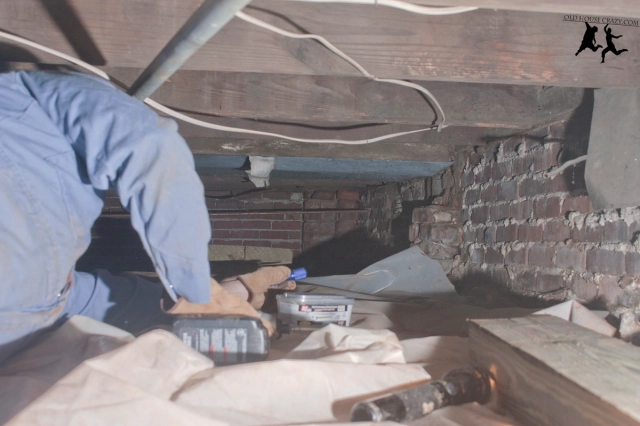
The crawlspace was really tight in the area nosotros were working. Luckily, it was pretty dry. The vapor bulwark and outside drainage had washed their chore well.
Below, you can come across my brother prepping one of the new joists by partially driving the screws into the wood. This is surprisingly difficult to practice when belongings a twenty pound joist and a drill above your head while lying on your back.

I used to balk at the drills and power tools that come up with a calorie-free. Not any more. That little light came in very handy.
With the mud and the muck, I didn't become whatever photos of the adjacent step or two. In the photo beneath, you see the last production. You can see how the new joists are fastened and, if y'all look towards the background, how they overhang the old joists and then the support axle is just pushing on the new joists.

Hither's the completed job. The new joists are fastened to the old joists and are supported by the 4×four'due south and screw jacks.
Once the new joists were upwards, nosotros found locations where the concrete blocks could sit flat on the ground so the force per unit area wouldn't cause them to crack. Afterwards they were in place, we hoisted up the 4″x6″x8′ axle so that it crossed all four of the new joists, sliding the screw jacks underneath. With the beam resting nicely on the jacks, we slowly turned the red handles until the beam was in contact with two of the joists. And so we kept turning until it was in contact with all iv of the joists (the lower 2 lifted up to be in line with the higher 2). By yelling through the floor to my blood brother'due south wife, nosotros were able to coordinate our irksome turning of the screw jacks until the crack betwixt the floor and the base board was gone.

Here'southward the final product. Total, this job cost my brother $150-$200, where a pro would easily have charged $800-$1000. I'll admit, this is probably not the job for a get-go time do-it-yourselfer, merely folks with a little experience and conviction tin easily repair the sagging floors in their homes.
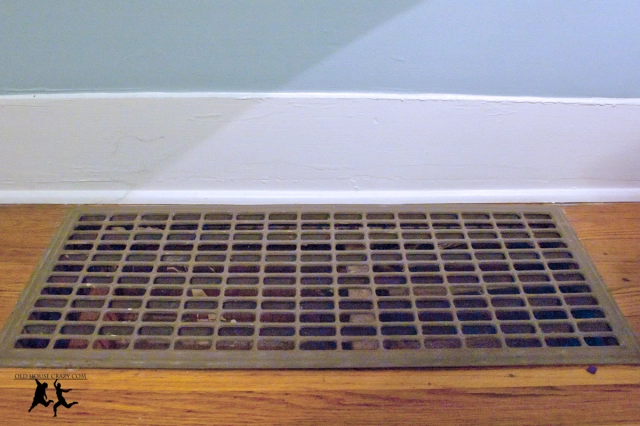
Await for the 1-inch gap between the floor and baseboard. Information technology's not there any more.
The before and later is beneath. If y'all've got questions or comments, leave them below or contact u.s.a. at oldhousecrazy@gmail.com. Too, feel free to leave us a comment on our facebook page www.facebook.com/oldhousecrazy. Cheers for reading. -Robby
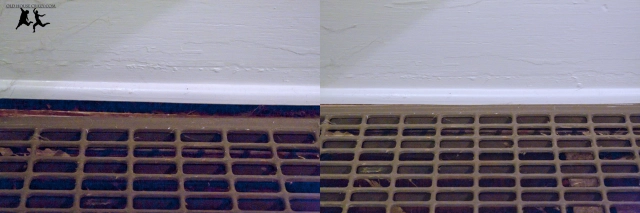
Before and Afterward

Source: https://oldhousecrazy.com/2012/01/23/lifting-up-a-sagging-floor-diy/
Posted by: hurlbutmonatur.blogspot.com
0 Response to "How To Repair Floor Joist Top Rotted"
Post a Comment