

What Does It Cost To Repair F150 Fender Wheels

In motorsports, a pit stop is a pause for refuelling, new tyres, repairs, mechanical adjustments, a driver change, as a penalty, or whatever combination of the to a higher place. These stops occur in an area called the pits, most commonly accessed via a pit lane which runs parallel to the commencement/end straightaway of the track and is connected to it at each end. Along this lane is a row of garages (typically 1 per team or car) outside which the work is washed in a pit box. Pit stop work is carried out by the pit crew of upwardly to twenty mechanics, depending on the serial regulations, while the driver often waits in the vehicle (except where a driver alter is involved or in motorbike racing).
The term is also used generically to draw a short suspension in a journey.[1]
Location and terminology [edit]

Depending on the circuit, the garage may be located on pit lane or in a separate area.
In nigh serial, the order of the teams' pit boxes is assigned by points standings, race results, or previous qualifying results before the kickoff of the race. In NASCAR and in INDYCAR's Indianapolis 500, typically pit assignments are made after qualifying, with the fastest qualifiers choosing their pit stall outset.
Most North American circuits characteristic a pit lane with a number of pit stalls (typically 30–50) and a pit wall that separates the pit lane from the infield, with the garages (if used) on a separate road in the infield. In races where there are different series racing together, each serial has its own separate garage or are parked in their own area. Circuits in other parts of the world (used in Formula I) typically accept the individual garages open straight onto the pit lane through the team's assigned pit box. In American English, it is common to drop the definite article and but refer to "pit road", whereas in British English one would always refer to "the pit lane". A further divergence is that in British English, the term "pit box" is universally used, whereas in American English, 1 would say "pit stall". Information technology is important to note that in NASCAR, a pit box is a tool (meet below), though there is a definitive term used for them.
Purpose [edit]

Pit terminate in 1964 at Nürburgring
Where it is permitted, refuelling is often an of import purpose of a pit stop. Carrying fuel slows downwards a vehicle, and in that location is often a limit on the size of the fuel tank, so many races crave multiple stops for fuel to complete the race distance in the minimum fourth dimension. Irresolute tyres is also common, to permit the use of softer tyres that article of clothing faster but provide more grip, to utilize tyres suitable for wet conditions, or to use a range of tyres designated past the rules. Teams will aim for each of their vehicles to pit following a planned schedule, with the number of stops determined by many factors, such every bit fuel capacity, tyre lifespan, and the merchandise-off betwixt fourth dimension lost in the pits versus time gained on the rail due to the benefits of pit stops. Choosing the optimum pit strategy of how many stops to make and when to brand them is crucial in having a successful race. Information technology is also important for teams to take competitors' strategies into account when planning pit stops to avoid being held up behind a competitor where overtaking is difficult or risky. An unscheduled or extended stop, such as for a repair, can be very costly for a commuter'southward hazard of success, because while they are stopped for service, competitors remaining on the rail are gaining time on them. For this reason, the pit coiffure ofttimes undergo intensive preparation to perform operations such as tyre changes as rapidly every bit possible, leading to pit stops, for case, as in Formula 1, where the automobile is only stationary for a few seconds for a regular pit stop.
General strategy [edit]

In whatsoever racing series that permits scheduled pit stops, pit strategy becomes ane of the most important features of the race; this is because a race machine travelling at 100 miles per hour (160 kilometres per 60 minutes) will travel approximately 150 feet (45 metres) per second. During a ten-second pit terminate, a auto'due south competitors volition gain approximately one-quarter-mile (400 metres) over the stopped car.
Withal, the car that made the additional pit stop will run faster on the race track than cars that did not make the terminate, both because information technology tin carry a smaller amount (and thus lower weight) of fuel, and will besides have less habiliment on its tyres, providing more traction and allowing college speeds in the corners. In racing series where teams have their selection of different chemical compound tyres, the lower tyre wear may be plenty to allow the team to choose to employ a tyre with a softer safety compound that provides increased grip at the expense of faster wearable; going longer betwixt stops may even crusade plenty wear on the softer tyre to cause the tyres to fail.
Because of this, race teams plan a pit strategy prior to the start of every race. This is a schedule for each machine's planned pit stops during the race, and takes into account factors such as rate of fuel consumption, weight of fuel, cornering speed with each available tyre compound, rate of tyre wear, the issue of tyre wear on cornering speed, the length of pit road and the track's pit route speed limit, and even expected changes in weather and lighting conditions. The pit strategy does not just include a schedule of when pit stops volition happen; it also includes what service and adjustments are scheduled for each pit stop, particularly in endurance racing, where scheduled changes of article of clothing-express parts such as restriction pads may be planned for specific points during the race. The pit strategy is calculated advisedly and so that the amount of time to be "given away" to other competitors in pit stops is balanced by the fourth dimension gained while on the rail, resulting, theoretically, in the shortest possible time to encompass the scheduled distance.
Withal, a team's pit strategy is non a stock-still, immutable thing; it is subject to change during the race to take into account the unpredictable events that happen in every race. In route racing, for case, if the weather condition changes from dry out to pelting, teams will exist forced to recalculate their pit strategy based on the unscheduled end to alter from dry-weather "slick" tyres to treaded moisture-conditions tyres. Safety car periods often run across mass pit stops by many teams, hoping to take advantage of the slowed step to reduce the ground lost to other teams while making pit stops; this forces teams that do so to immediately recalculate their pit strategy to optimize it for the remaining race distance after the terminate.
Even when a team chooses non to take advantage of the opportunity to stop during a full-course caution, information technology can still result in significant changes to pit strategy; under caution, the cars run at a reduced speed that results in greatly reduced tyre article of clothing and fuel burn for a distance travelled. Depending on the circumstances, this may be plenty for a squad to gain more by choosing not to pit, hoping that the reduced fuel burn and tyre wear will let them to make one pit stop fewer than the other teams, assuasive them to proceeds distance and fourth dimension on their opponents. At tracks noted for frequent total-course cautions, teams may even plan their entire race strategy around this, using a suspension and aerodynamic setup suited to brusque sprints instead of extended runs to gain positions in the brusque bursts of greenish-flag racing, and planning their pit strategy on the assumption that cautions will extend their fuel mileage and tyre wear enough to make fewer stops than would otherwise be needed to consummate the race altitude.
Services performed [edit]

Veteran pit crew member Jim Hersey holding pit 'lollipop' sign to betoken the commuter (Excursion de la Sarthe, 2022)
During a scheduled pit stop, the team'due south pit coiffure services the vehicle every bit rapidly as possible, completing a number of different services. The near common services performed are refuelling (where permitted) and changing tyres.
Other services performed in routine pit stops include removing debris from radiator air intakes, cleaning the windscreen, and making adjustments to tyre pressure, suspension settings, and aerodynamic devices to optimize the vehicle's operation for the current conditions. In endurance racing, scheduled driver changes and brake pad replacements are also considered "routine" service when done every bit office of a scheduled pit stop.
An unscheduled pit stop may come across other services performed; because unscheduled stops are oftentimes due to harm or mechanical problems, they may include emergency repairs and replacement of parts.
In some forms of racing, a team may be ordered to bring a vehicle into the pits as a penalty and either drive through the pit lane at the maximum permitted speed or remain stationary in their pit box for a specified period of time. During this time no services can be performed.[2]
Formula One [edit]
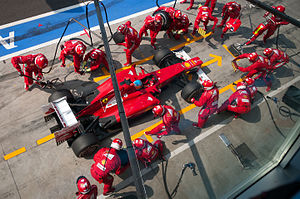
In Formula One, mid-race refuelling has been banned since 2022, and cars make pit stops with the master purpose of changing tyres. Teams sometimes also make adjustments to the forepart and rear wings and perform minor repairs, well-nigh normally replacing the nose and front fly assembly. A pit end typically takes 2 to 3 seconds to consummate. Red Bull Racing holds the current earth tape for the fastest pit stop, with a one.82-2nd terminate performed at the 2022 Brazilian Grand Prix on Max Verstappen. Pit strategies generally call for between one and four scheduled stops, depending on the circuit. The drives betwixt pit stops are ordinarily known every bit 'stints'.
When the car is approximately ane lap away from making its stop, the team's pit crew will prepare upward fresh tyres and all needed pit equipment. Because of the overhead pneumatic rig, the squad may take all pit mechanics in position prior to the car's arrival, with the exception of the rear jack man.
Unlike nearly all other forms of racing that feature routine pit stops, Formula 1 rules limit teams to a single pit crew for the mandatory two cars entered. Most other racing series that characteristic routine pit stops permit each car its ain pit stall and coiffure. Therefore, teams must stagger their pit schedules and then that only 1 of their two cars is in the pits at any given time; otherwise, one car must wait for the other car to terminate services. Yet, with proper timing or in special weather condition (for example, in the flow immediately after the safety machine beingness called out), it is possible for teams to pit both cars on the aforementioned lap without losing meaning time; this is known every bit the 'double stack' strategy. This allows both of the team's drivers to race on equally fresh tyres, preventing either from having an advantage over the other, and helps the team hide the relative performance between 2 cars to other teams when only one car is in the pits.
Ane strategy ordinarily used in Formula 1 pit stops is the 'undercut' involving two cars battling for track position. In this strategy, the car behind makes an earlier pit stop than the leading automobile; if successful, the car behind should exist able to apply the advantage of having fresh tyres to reduce the atomic number 82 of the car they are attempting to overtake. If the gap betwixt the two cars is reduced to less than the fourth dimension lost in a pit stop, when the leading auto pits, the leading car volition exit the pits behind the car which pitted first. This strategy is especially effective when the leading car is stuck in traffic and/or if the car behind has clear track to button on, only can exist negated if the automobile behind gets stuck in traffic after their early pit finish or is unable to drive fast enough to neutralize the advantage of the leading auto. Similarly, in that location is the reverse (but less common) strategy of the 'overcut', where the leading car stays out on their older tyres longer and laps fast plenty to maintain or even extend their advantage over the machine behind—this strategy may be successful if the leading car's tyres are still in proficient shape when the automobile behind pits, sufficiently so that the leading car can push without being overly limited past tyre deposition, or if the car behind gets stuck in traffic, thus negating their ability to utilise their fresher tyres to their advantage.
Refuelling [edit]
Refuelling, now banned in F1 races, was permitted from the 1994 season to the 2009 season. During this catamenia, a pit stop involved about twenty mechanics, with the aim of completing the terminate equally rapidly as possible. Stops mostly lasted for six to twelve seconds, depending upon how much fuel was put into the car. However, if there was a problem, such as a fuel pump declining or the engine stalling, or repairs having to exist made, information technology could accept much longer. Cars were fuelled at a charge per unit of more than 12 litres per second. This was achieved past a fairly complex airtight arrangement that pumped air out of the car'southward fuel tank as the fuel was being pumped in.
Since fuel was a pregnant portion of a car's weight, teams varied the amount of fuel loaded into a car at whatever given stop (and prior to the race) and thus vary the number of pit stops. The most common strategies seen were one-cease and 2-stop strategies; two-stop strategies were employed to increase the auto's speed/meliorate lap times to catch cars ahead, whereas one-terminate strategies were used to gain fourth dimension and track position to cars ahead with the advantage of one fewer pit stop. However, teams could and sometimes did opt for unorthodox pit strategies with multiple (three+) pit stops, as was employed by Ferrari and Michael Schumacher with 4 stops at the 2004 French G Prix, which he eventually won.
Every bit refuelling was a potentially hazardous state of affairs, the mechanics wore fire-resistant multi-layer suits and flame-resistant gloves, long underwear, balaclava, socks and shoes, which had to run into the guidelines set up by FIA Standard 8856-2000.[three]
F1 pit crew roles [edit]

- Iv bicycle-gunners or tyre changers, one for each bike/corner of the machine, use a pneumatic wrench ("tyre gun") to remove the car'southward unmarried locking lug nut from each tyre then reinstall it on the new tyre.
- Viii tyre carriers are used (four each of cycle-off and wheel-on), two for each wheel/corner of the motorcar, ane to remove the old tyre from the motorcar and one to put the new tyre in place.
- Two stabilisers stabilise the car on each side at the middle of the car.
- The front wing men, if necessary, adjust the forepart wing bending (to provide more/less downforce) and/or change the entire front wing (in instance of damage sustained during the race).
- The front and rear jack men use lever-blazon jacks to elevator the car and permit the changing of tyres during the pit stop.
- The job of the front end jack man is mostly considered the almost hazardous of the entire pit crew, as it requires standing directly in front of the auto as it enters its pit box. Mechanics in this part have been injured in the past when drivers have overshot/failed to brake in fourth dimension for their pit box.
- By contrast, due to the location of his duties direct behind the auto, the rear jack human being is the only team member non in his working position before the automobile enters its pit box.
- The burn extinguisher man stands prepare with a manus-held fire extinguisher to put out any fires that may occur during a stop, at least long plenty for the pit coiffure and driver to evacuate. This job became standard following Jos Verstappen's 1994 pit burn down.
- Sometimes, more than one pit crew fellow member may perform this role if a car comes in for an unscheduled stop with mechanical issues involving a fire/excessive heat (e.g. overheating brakes).
Deprecated roles
- The lollipop man held the team's pit sign (nicknamed the "lollipop" for its circular shape, hence the proper noun of the role), helping the driver place his pit box on the pit lane and holding it in position during the stop to remind the driver to continue his brakes on while tyres are being changed, to remember to put the car in starting time gear once the jacks are lowered, and finally to signal the commuter to leave the pit box once the pit end was complete by raising the sign.
- Nowadays, this office is carried out by a traffic calorie-free organization—drivers drive into their squad pit by retention or by watching the crews out on pit lane and are signaled to leave the pit box past a serial of lights suspended over the driver'due south caput in the pit box controlled from the garage.
- The refueling man managed the refueling system for the car, hooking it in place during the pit stop and disengaging it when refueling was complete.
- With refueling having been banned in F1 from the 2022 season onwards, this function is no longer necessary as cars no longer refuel mid-race.
- The starter human being stood ready with a starter tool to restart the car should the driver stall his engine during the pit cease.
- Present, as modernistic F1 cars have anti-stall systems and can be started by the driver independently if needed using the car's bombardment, this role is no longer necessary, unless a state of affairs calls for a complete engine reset.
Formula E [edit]
For its commencement four seasons, pit stops in Formula E served the primary purpose of changing cars—since FE cars did not yet incorporate the necessary electric accuse to consummate a full race, drivers needed to switch cars during the race. With the exception of repairing damaged tyres, no other mechanic services were allowed to be performed on the cars during the pit stop.
Prior to the 2022–18 season, the rule and scoring system in Formula E allowed for some unusual pit finish strategies. Previously, drivers scored ane bespeak for setting the fastest lap in the race regardless of finishing position (or whether they finished the race at all); hence, a commuter with no chance at finishing in the indicate-scoring positions for whatever reason could switch cars, wait for the prematurely right moment to come up out of the pits and ready the fastest lap of the race. Notably, this was seen in the 2022 London ePrix, when championship contenders Sébastien Buemi and Lucas di Grassi utilised this strategy afterward their outset lap crash rendered them otherwise unable to score points; Buemi ended upwards with the fastest lap, winning the Formula E 2022 drivers' title equally a direct result. For the 2022–18 season, Formula E'southward rules were amended to restrict the boosted point for fastest lap to drivers finishing in the top 10 only, rendering the same strategy obsolete.
For Formula East'southward fifth season (2018–19), new cars were introduced which had batteries capable of completing the entire race distance; thus, such pit stops were no longer used during races, other than in the effect of repairing damage.[4] Plans are underway in Formula East to bring dorsum pit stops in a race, but this fourth dimension it would exist not to change tyres or the car but to charge the car using high speed electrical charging stations. The details are nevertheless to be finalised.[v]
NASCAR [edit]
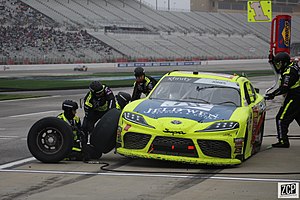
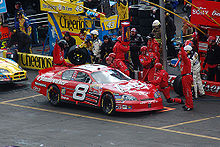
Crew chiefs lead the pit crew during pit stops in addition to coaching the driver during the race. Pit coiffure members were once the mechanics on the racecar, but nearly teams feature individuals dedicated to pit stops only, and often onetime collegiate or professional athletes are used for pit stops. Former NFL player Tim Catalyst is regarded as the commencement former professional athlete involved in a pit crew, as a jackman. Still, some pit crew members work with the team in fabricating or designing the race cars during the week while preparation for their "pit task" on the weekends. Teams accept built total preparation centers similar to that of professional athletes for their pit crews.
There are a number of penalties that can exist incurred on a pit end. The driver must keep the car beneath the pit route speed from the pit archway to the pit exit; the speed limit is typically 35–55 mph, depending on the size of the track. Teams can be penalized if the car is serviced outside of the designated pit stall, if the car drives over an air hose, or if whatsoever of the old tires are non on the pit wall side (unremarkably left) of the vehicle's centerline before the car leaves. The most mutual penalty for a pit infraction is a "drive-through": the driver must enter the pits again, under the green flag, and maintain the pit speed limit for the unabridged length of pit route. If a motorcar stalls, the pit crew may provide a push button offset, but the car cannot be pushed beyond iii pit stalls ahead of its ain, or beyond the pit go out low-cal and steward at the end of pit road.
Pit stops are timed from the moment the car stops in its pit stall until service is finished and the machine leaves the stall. A pit stop for iv tires and fuel tin can last 12 to xvi seconds, and a stop for two tires and fuel may take 5 to 7 seconds. Late in a race, a squad may only demand a small-scale corporeality of fuel to make information technology to finish; this is called a "splash and become" and may accept as little as ii to 3 seconds. These times depend upon any pause adjustments performed and the quality of the crew.
NASCAR Cup Series team pit strategies vary widely, depending on the track. Fuel is mostly a more than limiting cistron than tire wear, and the phrase "fuel window" or "pit window" is used to bespeak the maximum number of laps possible with a full load of fuel, assuming continuous green flag conditions and a pocket-size reserve. The window is used to calculate (or recalculate after a terminate) the minimum number of pit stops required to complete the race. The route courses on the schedule may run across equally few every bit 2 scheduled stops; oval race tracks generally see between four and six scheduled stops. Races at brusque tracks such as Bristol Motor Speedway and Martinsville Speedway are brusk enough to be completed with only two scheduled stops for fuel, but teams plan on more stops due to rapid tire wear and pregnant loss of cornering speed on worn tires. If ane team pits for tires and is considerably faster (between ane and 3 seconds per lap), then teams will commonly follow quickly to avoid losing time.
Pit strategy can play a meaning role in the outcome of a NASCAR race, perchance more and so than other racing series. Under circumspection, well-nigh teams use like strategies to avoid beingness caught lonely, typically post-obit the leader's decision to stay out or pit, but sometimes teams will deliberately pit "off-sequence" if they experience they tin gain an advantage later. Race tactics can affect strategy as well. Late in a race, drivers tin can reduce throttle input to save fuel at the cost of slower lap times, merely by doing so they can stretch their pit window to the stop of the race and skip the terminal pit end. A late circumspection can force teams to make a tough call: Stay out on worn tires, or pit and requite upwardly track position. The dark-green-white-checker rule can cause headaches, as it can potentially extend the race an unknown number of both green-flag and yellow-flag laps. Furthermore, strategy tin be determined by qualifying position. A squad that qualifies in the height half-dozen positions volition accept the best pick of pit stalls, nearly oft choosing the starting time, last, or a stall with an opening either in front of or backside that one. A team that qualifies deeper in the field volition have a greater opportunity to exist stacked behind cars during a pit terminate, slowing them down.
NASCAR pit coiffure roles [edit]

Typical pit box in NASCAR

- The crew primary is the leader of the pit crew. They are responsible for all aspects of the crew, auto set-upward (from the construction of the machine at the shop down to in-race handling adjustments), and at-track activities. They call the team'southward pit strategy (usually with the help of one or more than race engineers who monitor telemetry) and volition hire a pit crew bus to help coordinate the pit stops and train the pit crew members to stay in good concrete shape. NASCAR regulations dictate that only 5[six] individuals can go "over the wall" to service a racecar during a pit end. The tool limits on the crew are two impact wrenches, one jack, and two cans of gasoline. Other tools may be used if needed, but major work must be performed in the garage expanse. An important tool used past the coiffure chief is referred to as the pit box, but colloquially called the "war wagon". The pit box is generally equipped with flat-screen monitors and the television circulate of the event. These tools are used to help analyze the car up shut during any moment of the race.[seven]
- The car chief performs a majority of the scheduling and day-to-day preparations at the store prior to the race weekend. This person is responsible for managing the crew throughout the weekend, ensuring that the auto meets all of NASCAR's inspection requirements, and overseeing changes to the automobile requested past the crew chief or the squad engineer.[8] This role is similar to that of a chief operating officer'due south in general. If the crew chief is non able to attend the race, the car chief will occasionally serve as acting crew chief.
- The jackman raises each side of the car and then that the tires can be replaced. This person must practise this quickly with the use of a 22-pound (10 kg) floor jack.[9] while likewise removing and reinstalling the rear tires since the removal of the rear tire carrier. The jackman signals for the driver to leave the pits by lowering the machine.
- The two tire changers remove and tighten the lug nuts on the tires using a specification impact wrench (or "air gun") fabricated by Paoli (prior to the 2022 season, air guns were open to development, and height teams oft congenital their own from scratch). One tire changer is solely responsible for the front tires, while the other is responsible for the rears. NASCAR requires a wheel to have five traditional lug basics, as opposed to the single locking lug nut seen in other professional racing categories. Many jackmen lookout the tire changers to brand sure the lug nuts are tight, as NASCAR rules state that all five lug nuts must be in contact with the wheel.
- The gas man fills the car with Sunoco Greenish E15 racing fuel using a special gas can. The gas human being is usually prohibited from doing any other work during a end, but may also help pull old tires from the race car after lug nuts are loosened if the motorcar does not need fuel. Prior to the 2022 season, an boosted sailor (the "grab-tin can" man) was allowed over the wall to hold a special can over the car'southward fuel system overflow port to collect any spilled fuel. NASCAR disallowed the catch-tin can man in 2022; now the fuel cans are cocky-venting to reduce spillage.
- The tire carrier brings new outside tires over the pit wall and removes and installs the forepart tires. They must maintain command of old tires every bit they are being taken back to the wall, where boosted team members will have the new inside tires fix and waiting. The front tire carrier is usually responsible for pulling damaged front fenders abroad from the tire if necessary. He may also be responsible for cleaning and adding or removing tape to/from the grille during a pit stop in gild to accommodate forepart-end downforce and engine temperatures.
- The utility man is simply permitted over the wall in the second half of the race (sometimes before if conditions and NASCAR dictate otherwise). He may clean the windshield and provide the commuter with fresh drinking water and other necessities, simply he may non make whatever other adjustments to the car.
IndyCar Serial [edit]

In the IndyCar Serial, a pit cease is a more complex functioning than in NASCAR, but far less so than in Formula One. Rules permit 6 mechanics over the pit wall during a finish. The pit rules and procedures have origins in USAC National Title racing. The spare fuel for IndyCar competition is stored in large pitside fuel tanks. Each squad's tank is filled to a specified volume of fuel, depending upon the race altitude. Teams are likewise given a sure resource allotment of spare tires sets, besides attributable to the race distance. All of the spare tires are pre-mounted on wheels before the race.
During a routine pit terminate, the tires are laid out beforehand, and three of the 4 tire changers are pre-positioned earlier the car enters its pit stall. The fourth tire changer, whose responsibility is the rear tire on the far side of pit route from the pit wall, does not take his position until after the car arrives, due to a dominion against having the automobile run over the feed hose for the touch wrench used to alter the tires, and a prohibition of using an overhead boom to back up air hoses. As a consequence, the outside rear changer as well serves to wave at the commuter to inform him of where his pit box is while holding the air hose up.
Equally soon as the car comes to a halt, the first step, taken while the quaternary tire changer assumes his position, is for a mechanic to activate the car's built-in pneumatic jacks. A pressurized air hose is inserted into a receiving nozzle at the rear of the auto, under the rear wing. Previously, this device was inserted on the side of the car, just for safety reasons, the location was moved in the 2000s. At the same instant, another crew member begins the refueling process. A fueling hose is inserted into a socket (called the "buckeye"), allowing a gravity-fed hose to refill the machine's fuel tank. The fuel hose has a born vent/overflow hose as part of the mechanism, an invention of the mid-2000s. Previously, a second "vent hose" was utilized, only information technology was phased out to better safety.
Simultaneously, the four tire changers remove the wheels and install the new ones. IndyCar wheels are affixed to the hubs with a single lug nut, making it easier and faster to change them. Later the tire changes are complete, the front end tire changers may use transmission adjusters to adjust the angle of the car's front end wing, remove debris from air intakes, or make other minor repairs. While the service is being completed past the over-the-wall crew, another crew member behind the wall may use a stick to offer the driver a refreshment.
Afterwards the tire changes are complete, the air jack hose is removed, dropping the machine to the basis. All the same, the commuter usually must wait boosted seconds until the refueling is complete. The right front tire changer (who is normally also the coiffure chief) signals the commuter when the stop is complete. Before the auto departs its pit stall, a coiffure member must squirt water to wash whatever excess spilled fuel from the fuel buckeye; this is usually done with a pressurized water hose by a coiffure member backside the pit wall.
Under normal conditions, a routine stop for an IndyCar team lasts between half dozen and ten seconds. IndyCar teams are permitted to fix their ain pit strategies.
Super Formula [edit]
In Super Formula, Japan's top-level single-seater serial, a full of six mechanics are allowed to work on a car. Of these six, three take stock-still roles: the lollipop-signalman, the refueler, and the burn down-fighter. They are forbidden from undertaking any other function during the pit terminate. The remaining three mechanics are responsible for all other operations, well-nigh notably jacking upward the car and changing the tyres. The general strategy is to take the three free mechanics operate on the motorcar in an assembly-line-like manner, moving around the car betwixt different stations. Because of the limited personnel, teams frequently come upward with creative solutions to decrease pit stop times. For example, some teams employ an automatic front jack, which is placed in front end of the car as it stops. Mechanics might likewise spring over the nose-cone of the motorcar to relieve time getting to the other side. With the automatic front jack, a Super Formula pit stop takes betwixt ten and twelve seconds; even without the automatic jack, pit stops tin can exist completed in every bit little as 14 seconds.
Endurance racing [edit]

In the various forms of sports motorcar endurance racing, pit stops are a more leisurely matter, just no less of import than in other forms of racing. While stops take longer, much more routine maintenance is scheduled during such pit stops, needed to keep the car running for as long as xx-four hours; this includes major aerodynamic changes to deal with the changing temperature in such a long race, and replacement of certain wear-limited parts, such as restriction pads. Due to the fact that the race is scheduled to concluding a certain length of fourth dimension rather than a specific altitude, pit strategies are generally not designed to be synchronised with the race altitude, merely rather to happen on a schedule based on the automobile'south requirements for routine service.
Under the rules of the Car Society de l'Ouest (ACO) only five mechanics are permitted to work on the car. One man is permitted to fuel the car; all fuelling must be completed before whatsoever other service occurs. The other four mechanics on pit lane at any given time are typically 2 tyre changers and ii tyre carriers, each of whom handles his task on only one side of the car. Automatic pneumatic jacks are used, integrated into the car itself. At all times the car's engine must be shut off during the stop, and may outset simply when the cease has concluded.
IMSA allows only iv mechanics to service a car during a pit stop. One coiffure member will refuel the car while the other 3 are responsible for irresolute tyres and operating the pneumatic jacks. A fifth coiffure-fellow member must serve every bit the team's designated firefighter and must stand ready in the pit stall with a fire extinguisher while the automobile is being refuelled. A sixth crew-member may assist in a driver alter. Neither the firefighter or driver's banana may perform whatsoever boosted service to the car.[10] Unlike the ACO, IMSA does not force crews to wait for fuelling to complete earlier changing tyres, and does not require the car'south engine be close off during the terminate.

In endurance racing, commuter changes are mandatory; the shortest endurance races are scheduled for four hours, one 60 minutes longer than the longest nonstop time permitted backside the wheel. During a pit stop with a driver change, the new driver and a driver change assistant are permitted into the pit lane. The assistant, who may not exercise any mechanical work on the car, is tasked with helping the current driver out of the automobile, removing or swapping driver seat inserts, helping the new driver into the automobile, and helping the new driver tightly fasten his safe harness and connect his various helmet connections to the motorcar's systems, including the ii-way team radio and the drink bottle used to stave off dehydration.
A routine pit stop with no scheduled maintenance and no commuter change generally lasts from thirty to forty seconds. With a driver change included, that fourth dimension increases by about ten seconds. Should there be significant scheduled maintenance, such equally changing brake pads, the finish tin hands final well over a infinitesimal.
Unlike about other forms of racing, the practice of "double-stinting" or even "triple-stinting" tyres is commonplace in longer races; tyres hard enough to withstand the rigours of racing in the heat of the daytime may be so hard that they do not wear significantly during the nighttime hours. In a race where this is an consequence, significant time tin can be gained by choosing to leave worn tyres on the car during the first cease after they were put on the car; if the temperature drops depression enough, teams may even be able to go 2 pit stops without changing tyres.
Notable pit stops [edit]
- 1963 Daytona 500: Wood Brothers Racing developed choreographed pit stops to reduce the amount of time spent on pit road. Driver Tiny Lund spent so little time on pit road that he went on to win the race without changing his tyres one time. For this, Wood Brothers Racing is often credited with inventing the modern pit stop.
- 1965 Indianapolis 500: Wood Brothers Racing was invited by Ford to service the Lotus 38-Ford driven past Scottish Formula I driver Jim Clark. This brought their new concept of fast pit stops into open up-wheel racing. Clark won the race with an boilerplate speed of 150.686 miles per hour (a new Indianapolis 500 record). This was Ford'southward first win at Indianapolis.
- 1976 Indianapolis 500: A world record was ready for time taken in a pit-stop when Bobby Unser pitted in four seconds.[xi]
- 1981 Daytona 500: During the last round of pit stops, Richard Petty'south crew chosen off a planned tyre change, and serviced fuel simply. The lightning-fast stop put Petty dorsum on the runway in the atomic number 82, and he held off a shocked Bobby Allison for a record seventh Daytona 500 victory.
- 1982 Indianapolis 500: Gordon Johncock and Rick Mears were running together on the track every bit they approached their concluding pit stops. Johncock's crew saved time past giving him simply enough fuel to finish the race, sending him out with an 11-2d atomic number 82. The better-handling Mears airtight the gap only ran out of laps as Johncock hung on to win past 0.16 seconds.
- 1989 Portuguese Yard Prix: Nigel Mansell came in too fast and missed his pit box. He then reversed back to accept his spot, and mechanics changed the tyres. Due to reversing in pit lane (as opposed to waiting for the mechanics to push him back), he was disqualified. He did not acknowledge the blackness flag, later collided with Ayrton Senna and was subsequently given a one-race pause.
- 1991 First Wedlock 400: After an offseason of discussion at the end of the NASCAR season during the Atlanta Periodical 500 when Melling Racing rear tyre changer Mike Rich was killed by Ricky Rudd's machine going out of control during a pit stop, NASCAR experimented with diverse rules on tyre changes in an attempt to prevent a similar incident from happening once more. The first was to only let tyre changes during green flag racing, with the first lap after the restart being assigned to cars that started in odd-numbered starting positions, and the second lap after restart for even-numbered starting positions. The rule was unpopular, and teams began to alter tyres simply for regularly scheduled times under the green flag. Subsequently the starting time five races, NASCAR experimented with a dominion for the Valleydale Meats 500 in Bristol. The same odd–even rules were used for the first ii laps of a pit stop under caution, with the cars starting double-file, with the odd cars on the inside and even cars on the outside. Later more complaints, for the seventh race, at North Wilkesboro Speedway, NASCAR reverted to the rules prior to the 1990 crash, along with a new rule mandating a pit lane speed limit. By the middle of the 1990s, almost all motorsport began enforcing a pit lane speed limit.
- 1991 Toyota Grand Prix of Long Beach: Michael Andretti's pit service was complete as he passed by Emerson Fittipaldi, who began exiting his pit surface area. Fittipaldi was apparently unaware that Andretti was approaching, and as the two made wheel-to wheel contact Andretti's car was launched into the air. Andretti's damaged car slid into another pit stall, but, though very angry, he walked away uninjured. As this incident took identify in the wake of the aforementioned Start Union 400, this incident prompted CART to mandate pit lane speed limits.
- 1991 Portuguese Grand Prix: Nigel Mansell lost a wheel instantly after making his stop. The mechanics put the wheel back on in the middle of pit road, and Mansell was butterfingers for the second time in 3 years in the effect.
- 1993 European Grand Prix: On lap 57, Ayrton Senna came into the pit lane for a tyre alter only aborted the finish and drove straight through instead. In the process, he ended up setting the fastest lap of the race, due to both the unique configuration of Donington Park'due south pit lane, and the lack of pit lane speed limits in F1 at the time (which would be introduced the post-obit year later Senna'south decease).
- 1993 Australian Grand Prix: McLaren'south Ayrton Senna came into the pit unexpectedly for new tyres; the team serviced the auto in under 4 seconds.
- 1994 San Marino Grand Prix: Michele Alboreto lost a wheel later on his pit finish. The wheel caused injuries to mechanics from Ferrari and Lotus. Following this and other tragic events during the weekend, the pit lane speed limit was introduced in Formula One.
- 1994 German One thousand Prix: Benetton driver Jos Verstappen came into the pits; while refuelling, some fuel was accidentally sprayed onto the hot bodywork of the car – a few seconds later the fuel ignited and Verstappen's machine was engulfed in a ball of flames. Verstappen escaped the incident with burns around his eyes, as he had his visor upwards during the pit stop.
- 1995 Castilian Grand Prix: Johnny Herbert exited his pit box with the rear jack yet attached to his car. It fell off harmlessly at the pit lane exit.
- 1996 24 Hours of Daytona: Max Papis was charging around the track on the last stint of the race, trying to catch the leader. On his terminal pit cease, Papis entered the pit area at full speed (~200 mph). Despite however finishing second, the startling sight helped earn him the name "Mad Max." This is no longer possible, as almost all federations decision-making motorsport take adopted pit lane speed limits because of crew safety.
- 1998 British Grand Prix: Ii laps from the finish, Ferrari driver Michael Schumacher was issued a 10-2d penalization. His team interpreted it as a requirement to drive through the pit lane without exceeding the speed limit, stop at a designated penalisation area, and remain stationary for 10 seconds before returning to the track. While driving forth the pit lane during the last lap, Schumacher crossed the finish line (which extended beyond the lane) earlier reaching the punishment area and before Mika Häkkinen could do then on the rails. The penalty was later rescinded, and Schumacher was declared the winner.
- 1999 Portland Thousand Prix: Gil de Ferran was leading just had bereft fuel to brand it to the finish. Rather than endeavour to conserve fuel, de Ferran's Walker Racing team instructed him to drive all-out to build enough of a margin to brand an extra pit stop. The strategy was a run a risk as a yellow flag would bunch the field and wipe out any margin de Ferran built. The dark-green flag stayed out, de Ferran pitted without losing the lead and he went on to take the squad's first win in four years.
- 2001 24 Hours of Le Mans: Joest Racing changed the transaxle on their Audi R8 (a procedure that usually takes hours) in less than five minutes. They went on to win the overall race.
- 2002 UAW-Daimler Chrysler 400: Sterling Marlin of Chip Ganassi Racing spun while attempting to make a late race pit end, causing him to break the pit road speed limit. At the time, NASCAR's penalty for speeding while entering pit road was to hold the commuter in his pit stall for an additional xv seconds. The official in Marlin's pit was non informed of the penalty until after the coiffure released the car. NASCAR determined that they had no precedent for forcing Marlin to return to the pits every bit his early release was their mistake (and they could not order him back for a finish and go penalty). Marlin won the race by 1.163 seconds.[12] Following the incident, NASCAR amended its rules so that all dark-green flag speeding violations are enforced with a bulldoze through penalty (forcing the commuter to travel the length of pit route at the speed limit).
- 2002 The Winston: Roush Racing'south Jeff Burton made a pit stop on the concluding lap of the offset forty-lap segment. A pit finish for tyres was mandatory during the segment, merely the rule did not stipulate when information technology had to exist taken. By selecting a pit stall only 100 yards shy of the start/finish line, Burton did not accept to spend the time all the other drivers took traveling the entire length of pit road.[xiii] Since Dart All-Star Race Xix, the rule was modified to mandate the stop inside a specific number of laps in the race.
- 2008 Canadian Yard Prix: Ferrari's Kimi Räikkönen came to a stop at the end of the pit lane as the exit was closed, with the red indicator calorie-free on. Räikkönen was alongside BMW's Robert Kubica at the end of the pit lane when Lewis Hamilton sped towards them not noticing the cerise low-cal at first. Hamilton slid into the back of Räikkönen'due south car, with Nico Rosberg further hitting the back of Hamilton. Both Hamilton and Räikkönen retired from the race, each leaving their vehicles at the exit of the pit lane. Both Hamilton and Rosberg were penalised a 10-place grid penalty at the next G Prix in France.
- 2008 Singapore Grand Prix: Ferrari's Felipe Massa drove off with the fuel hose even so attached to the machine knocking downwardly a member of the pit crew while he attempted to head back to the rail as he was mistakenly shown the green signal. The problem was later attributed to the failure of Ferrari's automatic light system. This beingness the starting time night race in F1, the Ferrari team subsequently resumed the apply of the traditional lollipop man for the remainder of the season.[14]
- 2011 Abu Dhabi Grand Prix: McLaren's Lewis Hamilton entered the pit lane and had his service in 3.19 seconds followed seconds later by teammate Jenson Button having a four-second pit terminate.
- 2012 Chinese Grand Prix: The Ferrari team completed a pit terminate for Fernando Alonso in 2.four seconds.[xv]
- 2012 German Grand Prix: The McLaren team completed a pit end for Jenson Push button in 2.31 seconds.[16]
- 2013 Malaysian Grand Prix: McLaren'southward previous record of two.31 seconds was bettered half-dozen times during the form of the race, the fastest of which came from Infiniti Red Bull Racing's pit stop for Mark Webber, completing the terminate in ii.05 seconds. Lewis Hamilton also had a notable pit stop afterwards accidentally driving his Mercedes motorcar into the McLaren pits, after only moving from the team two races prior.[17]
- 2013 German Grand Prix: Mark Webber was released from the pit box before his correct-rear wheel was properly fitted on. The tyre came loose equally he drove down the pit lane and hit a cameraman.[eighteen] This led to increased pit lane condom measures being implemented, including mandatory head protection for all team members working on a motorcar during a pit end, a reduced pit lane speed limit, and restricted admission for the media into the pit lane.[nineteen]
- 2013 GoPro Indy Grand Prix of Sonoma: While exiting his pit stall, race contender Scott Dixon struck Volition Ability's right rear tyre carrier, who was thrown into some other pit crew member, while another fellow member of Ability's coiffure was injured by an air gun. Dixon was penalised for the incident, but he believed the tyre carrier had intentionally walked in front of his machine. Power would get on to win the race, while Dixon's punishment relegated him to 21st, and a final finishing position of 15th.[20]
- 2013 Japanese Grand Prix: The Ferrari squad completed a pit cease for Fernando Alonso in 1.95 seconds.[21]
- 2013 U.s. Grand Prix: The Red Bull Racing Team completed a pit cease for Mark Webber which they timed at 1.923 seconds.[22] [23]
- 2016 European Grand Prix: The Williams Team completed a pit end for Felipe Massa in one.92 seconds.[24]
- 2018 Australian Grand Prix: Kevin Magnussen, driving for Haas F1 Team, was released from the pit box before all wheels were properly fitted. Two laps later, his teammate Romain Grosjean was likewise released with a loose wheel, forcing both drivers to retire. Haas was fined €10,000 for the unsafe pit releases.[25] [26]
- 2018 Bahrain Thou Prix: During Kimi Räikkönen's second pit stop, his Ferrari struck tyre changer Francesco Cigarini'due south left leg as it left the pit box, fracturing Cigarini'southward tibia and fibula. The cause of the incident was a sensor defoliation in the Ferrari pit box light system.[27]
- 2019 DXC Engineering science 600: Having led the race from pole position, Rahal Letterman Lanigan Racing's Takuma Sato entered the pits for his first stop at the end of lap 62 and overshot his pit box, hooking the inside air hoses and lollipop on his car and launching the inside front tire changer into the next pit box. The crewman was uninjured, simply the lengthy pit stop and subsequent penalty for hitting pit equipment left Sato iii laps down and out of contention.
- 2019 British Grand Prix: The Red Bull Racing squad completed a 1.91 pit end for Pierre Gasly, making it the 3rd fastest pit cease in F1 and overall.
- 2019 High german Grand Prix: The Cherry-red Bull Racing team completed a pit stop for Max Verstappen in ane.88 seconds,[28] making information technology the second fastest pit end in F1 and overall.
- 2019 Brazilian Grand Prix: The Red Bull Racing team completed a pit terminate for Max Verstappen in one.82 seconds,[29] making it the fastest pit stop ever in F1 and overall.
- 2021 Monaco Thou Prix: Valtteri Bottas of the Mercedes team was forced to retire from the race after his bicycle could not be removed from the car due to a faulty wheel nut.[30]
Run across also [edit]
- Water cease
- Chequered Flag, the first videogame to feature pit stops to repair damage and take on fuel.[31]
References [edit]
- ^ "Rawlinna". Jumbuck. Jumbuck Pastoral. 2022. Retrieved 16 August 2022.
- ^ "Penalties and driver protocol". Formula One. Retrieved 8 September 2022.
- ^ "Drivers' Equipment". Fédération Internationale de l'Automobile. Archived from the original on 2 Dec 2007. Retrieved viii Jan 2022.
- ^ Gitlin, Jonathan (fourteen December 2022) Formula E starts season v in Saudi arabia with a faster electric race machine Ars Technica. Retrieved 14 April 2022.
- ^ Kew, Matt (xvi July 2022). "Formula E could run longer races, bring back pitstops with new Gen 3 cars". Autosport . Retrieved 2 December 2022.
- ^ "NASCAR teams tuning up for new pit-stop rules | NASCAR.com". Official Site of NASCAR. 24 January 2022. Retrieved 6 May 2022.
- ^ "10 Essential Tools of NASCAR Pit Crew Members".
- ^ "NASCAR'due south Dart Cup Car Chiefs Relish Background Part". 18 June 2009. Archived from the original on 3 February 2022. Retrieved 19 April 2022.
- ^ "The beefcake of a pit cease". NASCAR Media Grouping, LLC. v January 2022. Retrieved 18 November 2022.
- ^ Grand-am.com Archived 11 July 2022 at the Wayback Machine 2009 Sporting Regulations. Retrieved 25 January 2009
- ^ "Bobby Unser sets world tape for fastest... May 30 in History". BrainyHistory . Retrieved 17 April 2022.
- ^ USAToday"Without penalization, Marlin speeds to Las Vegas win" Retrieved 12 January 2009
- ^ USAToday.com "Newman captures The Winston all-star event" 2/eighteen/08
- ^ sportinglife.com Archived v June 2022 at the Wayback Machine "MASSA RUES PIT-LANE ERROR" 29 September 2008
- ^ "Ferrari crew fastest with pit stops so far this season". yallaf1.com. 9 February 2022. Archived from the original on 9 February 2022. Retrieved 6 May 2022.
- ^ "formula1onlive.com". Retrieved 17 April 2022.
- ^ Padeanu, Adrian. "Mark Webber's ii.05s pitstop in Malaysia was the fastest e'er". Worldcarfans.com. Retrieved 8 January 2022.
- ^ "Mark Webber'southward wheel hits cameraman at the German Yard Prix 2022". The Daily Telegraph. London. 7 July 2022. Archived from the original on 10 July 2022.
- ^ "FIA fast-tracks pit lane safety changes". ESPN F1. 10 July 2022. Retrieved 8 January 2022.
- ^ "Power wins controversial race in Sonoma". Yahoo Sports. 25 August 2022. Retrieved 27 August 2022.
- ^ "Repetita iuvant". formula1.ferrari.com. Archived from the original on twenty October 2022. Retrieved 17 April 2022.
- ^ "Seb'due south great eight in us | Crimson Bull Racing Formula 1 Team". Infiniti-redbullracing.com. Retrieved viii Jan 2022.
- ^ Formula1Onlive "Red Bull Racing sets new F1 pitstop world tape ", Formula1Onlive. Retrieved iii April 2022.
- ^ "Baku pit stop record for Williams". motorsport.com. Retrieved 22 June 2022.
- ^ "Cross-threaded bicycle basics acquired Haas double DNF". Formula I. Retrieved 29 March 2022.
- ^ "2018 Australian G Prix: Race Report". Haas F1 Team. 25 March 2022. Retrieved 29 March 2022.
- ^ "Ferrari explains error that injured mechanic in Bahrain Grand Prix". Eurosport. Retrieved 13 April 2022.
- ^ "Ruby Balderdash break pit stop world record at Hockenheimring | DHL". inmotion.dhl . Retrieved 29 July 2022.
- ^ "Red Bull break the pit finish tape for the 3rd time in the 2022 season |DHL". inmotion.dhl . Retrieved eighteen November 2022.
- ^ "Valtteri Bottas out in Monaco as Mercedes pit woes return". planetf1.com . Retrieved 23 May 2022.
- ^ "Chequered Flag". Retrofusion. Archived from the original on 4 March 2022. Retrieved 8 January 2022.
External links [edit]
 | Wikimedia Commons has media related to Pit terminate. |
- A CG animation of a Pit Stop with fifteen mechanics
- A NASCAR Pitstop Video at NHIS – (23MB)
- A NASCAR Pitstop Video at NHIS – smaller version (1MB)
- A Sprint Cup Pit Stop

Source: https://en.wikipedia.org/wiki/Pit_stop
Posted by: hurlbutmonatur.blogspot.com
0 Response to "What Does It Cost To Repair F150 Fender Wheels"
Post a Comment